Astrophysics · Space Engineering · Design
Designing systems at the intersection of space engineering, astrophysics, and high-performance sailing.

Space Systems Engineering · Reverse Engineering Study
Politecnico di Milano — Space System Engineering and Operations · Prof. Michele Lavagna, L. Bianchi, M. Bussolino · A.Y. 2025–2026
Full reverse-engineering study of JAXA's AKATSUKI Venus Climate Orbiter, reconstructing the mission architecture from available scientific and technical documentation. The work covers mission objectives and drivers, requirements, trajectory and ConOps, propulsion, TMTC and link budgets, attitude determination and control, electrical power, thermal control, spacecraft configuration and structures, on-board data handling and system-level mass and resource budgets.
Full consolidated report · Team 9 · 2026

Technical Report
Independent research — Part of the Space Framework · March - June 2026
Consolidated thermodynamic and architectural study of the eXperimental aeroSpike Liquid Rocket (XSLR™), the chemical propulsion subsystem of the Skyraker™ hybrid propulsion system, the heart of Ikarus™. Starting from a structured trade study of four dual-loop cooling configurations for a linear aerospike engine derived from the Rocketdyne XRS-2200, the analysis selects a parallel full-expander architecture augmented by a hybrid Electric Expander Cycle (EEC) as the recommended baseline across all thrust classes from 22 to 250 kN. This replaces the spike-loop LH2 turbopump with a BLDC motor-driven centrifugal pump, enabling 5:1 throttle, combined cell shutdown and cold-start without pyrotechnic igniters.
Coming soon.
Technical Report
Independent research — Part of the Space Framework · March 2024 - November 2026
Design and construction report for Ikarus™, second vehicle in the Project Ikarus™ SSTO series. Goes beyond the Ikarus-X™ concept to explore hybrid electric/chemical propulsion surpassing the concept of traditional drones with non-throttleable single-burn solid rocket propulsion. Designed to test a de-rated version of the Skyraker™ propulsion system in atmosphere (TRL 4.5).
Coming soon.
Technical Report
Politecnico di Milano — Launch Systems · Prof. F. Maggi, S. Carlotti · A.Y. 2025–2026
Design of a hypersonic point-to-point transportation system for 6 passengers across ~20,000 km via ballistic arc, with ±20 km landing accuracy. Carrier: Scaled Composites Model 351 Stratolaunch. Propulsion: LOX/LCH₄ engines scaled from SpaceX Raptor 2 (TRL > 6). Crew capsule Sirius derived from NASA 2005 ESAS Orion, with Launch Abort System and triple-parachute recovery. Co-team leader, responsible for propulsion, structural analysis and capsule integration.
Last updated: January 2026
B.Sc. Thesis · Università degli Studi di Napoli Federico II
Supervisors: Prof. Giovanni Covone, Dott. Matteo Trudu, Dott. Andrea Melis · May 16th, 2025
B.Sc. thesis in Physics. Applied the Karhunen–Loève Transform (KLT) to datasets from the Sardinia Radio Telescope within the Breakthrough Listen programme. Validated the pipeline on Voyager 1 as a known artificial source; applied to TOI-1422 b, a Neptune-mass exoplanet in the habitable zone of a solar-type star. Results show significant RFI reduction and improved detection of weak technosignatures, following the theoretical framework of Claudio Maccone.
Defended: May 16th, 2025
Technical Report
Independent research — Part of the Space Framework · 2019
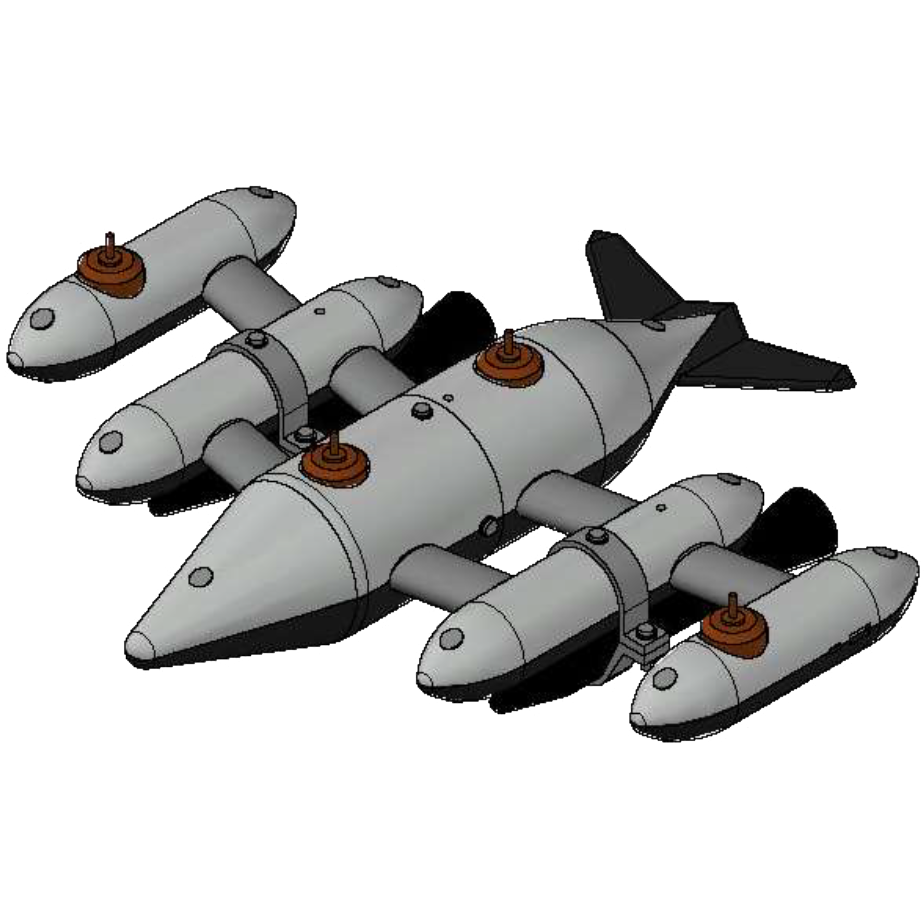
Design and construction report for Ikarus-X™. Explores hybrid electric/chemical propulsion as a testbed concept. Development began November 2017; series continued through Ikarus™ ""Gentoo" (see above).
First issued: 2019. Last updated: 2025 (translation to English only)
A concept for a new life between the stars · REDSTAR · Kvant · Skyraker · X-RAYJAR
Complete architecture for an interplanetary economy: REDSTAR modular stations, Kvant multi-purpose spacecraft for interplanetary travel, Skyraker propulsion system, X-RAYJAR fusion reactor. European-led post-OST governance framework.
Atmospheric testbed and technological precursor to the Kvant · Space Framework™ programme
The in-air backbone of the early framework. Acting much like the Enterprise for the Space Shuttle program, it serves as the benchmark to pioneer and validate the critical flight profiles, air-breathing capabilities, and onboard systems for the final, operational Kvant spacecrafts.
ISRU-enabled electric/chemical hybrid propulsion system · Space Framework™ programme
The heart of Ikarus™. A closed-loop ISRU chain: seawater → flash distillation → PEM electrolysis → H₂/O₂ → expander-cycle aerospike (XSLR) + microwave air plasma thruster (ICER). Water and fuel sourced in-situ from Earth oceans, Mars ice, or icy moon plumes (Europa, Titan, Enceladus).
Air-launched hypersonic suborbital transport
Malaga to Auckland in 55 minutes. Air-launched system for 6 passengers over ~20,000 km ballistic arc. Carrier: Stratolaunch. LOX/LCH₄ propulsion scaled from Raptor 2. Crew capsule "Sirius" from NASA ESAS Orion 2005, with Launch Abort System, triple-parachute recovery, ±20 km landing accuracy.
Foiling moth · Salone Nautico Venezia 2025
Chief Designer of a next-generation foiling moth published in the MUVE Academy Book, Salone Nautico di Venezia 2025. Frame inspired by NASA X-38 CRV; six-panel glassfiber wing on aluminum grid; electronic flight control system; modular construction for transport and rigging.
Modular amateur telescope
A modular segmented telescope concept that I designed when I was 15 years old. Inspired by the James Webb Space Telescope (JWST), Starseeker aimed at exploring advanced optical systems, deployable structures and segmented mirrors using amateur-level resources.
The Space Framework™ is a long-term European-led vision for integrating Solar System resources into the terrestrial economy while enabling a sustainable interplanetary transportation and industrial infrastructure.
The architecture is built around three core elements: REDSTAR™ orbital stations for research, habitation and space manufacturing, Kvant™ multipurpose spacecraft for crew and cargo transportation throughout the Solar System, and Skyraker™ propulsion systems enabling scalable in-space mobility and resource utilization.
The present implementation includes Noto™, an amphibious robotic explorer designed for Titan's hydrocarbon seas, extending the Framework toward outer Solar System resource assessment and future ISRU operations.
Beyond engineering, the Framework addresses the legal, economic and geopolitical challenges of large-scale space development, advocating stronger international cooperation and updated governance mechanisms for a future spacefaring civilization.
Read the full document ⤓
Architecture
REDSTAR™ + Kvant™ + Skyraker™
Integrated interplanetary infrastructure
Flagship Station
REDSTAR-1
ISS heritage · Reusable orbital backbone
Spacecraft
Kvant™
STS heritage · Solar System capable
Propulsion
Skyraker™
Hybrid propulsion · ISRU-oriented architecture
Outer Solar System
Noto™
Titan exploration and resource assessment
Future Energy
X-RAYJAR™
LiD crystal fusion concept
Applied the Karhunen–Loève Transform to Sardinia Radio Telescope datasets. Targets: galactic nuclei and TOI-1422 b, a Neptune-mass exoplanet in the habitable zone of a solar-type star (506 ly). Work became the subject of the B.Sc. thesis, supervised by Prof. Giovanni Covone.
2023 — on volunteer basis
Key projects: HyperLander, designed in a multidisciplinary team for the Launch Systems course, Akatsuki reverse engineering study, developed in another team for the Space Systems Engineering and Operations course, and femtosecond filamentation emission characterisation for the Laboratory of Plasma Physics course. Also active in the PoliMi Sailing Team.
2025 — present
Transferred from UniPV in July 2024. Graduated 16 May 2025. Thesis on application of the Karhunen–Loève Transform to SETI data, under the supervision of Prof. Giovanni Covone, Dott. Matteo Trudu, and Dott. Andrea Melis.
2024 — 2025
Led the team from September 2023 to July 2024 as Team Leader. Continued as Chief Designer, overseeing Lazarus — published in the MUVE Academy Book at Salone Nautico di Venezia 2025.
2021 — 2025
Undergraduate studies in Physics 2020–2024. Tutor for LaTeX and introductory web design. Continued collaboration with the Department of Industrial Engineering for the UniPV Sailing Team and the Lazarus project presented at Salone Nautico di Venezia 2025.
2020 — 2025
Served as cadet aboard the Italian Navy training ship Amerigo Vespucci. Operational experience in navigation and seamanship.
October 2022
Let's connect to discuss research projects, aerospace engineering initiatives, high-performance design work, or for conversations about the future of space exploration.